Over the past year, we’ve had multiple senior living organizations contact us after implementing NetSuite. That caught our attention. Selecting and implementing finance management software is one of the largest technology investments a finance department will ever make. Organizations spend months evaluating software, selecting a partner, redesigning processes, training users, and preparing for go-live. Once the project is complete, the expectation is simple: move forward and begin realizing the benefits.
So, when several senior living organizations reached out to discuss replacing a recently implemented ERP, we found ourselves asking the same question you probably are.
Why are Senior Living Organizations Replacing their NetSuite ERP?
Going into conversations with these organizations, we expected to hear complaints about their finance management ERP or industry functionality. Maybe a feature wasn’t available in NetSuite. Maybe reporting didn’t work the way they expected. Perhaps there were technical limitations they simply couldn’t work around.
That wasn’t what we heard.
Instead, they described what had changed – or more accurately, what hadn’t. The implementation was complete, but month-end close still required too much manual effort. Management reporting still took longer than it should. Finance was still spending too much time working around processes instead of simply working in the ERP. The software had changed, but the day-to-day work of the accounting department hadn’t changed nearly as much as they expected. That was the common thread.
These organizations made a significant investment in NetSuite, completed the implementation, and were now asking why finance hadn’t become any easier. One organization described processes that still relied on spreadsheets and outside applications long after implementation. Another talked about the amount of effort required every time that management wanted to look at the business from a new perspective. They talked about small inefficiencies that seemed manageable on their own but collectively consumed hours every week.
When “It Can Do That” Isn’t Enough
NetSuite is a powerful finance management software, and there is no question it can handle complex accounting, but that’s also where we think an important distinction gets lost during the ERP selection process. There’s a difference between an ERP being able to do something and making it easy for the finance team to do it.
Senior living puts that distinction to the test. An organization may have multiple communities, legal entities, departments, levels of care, and service lines. Corporate may pay expenses on behalf of individual communities. Allocations need to be run across entities. Leadership wants consolidated results today and individual community performance tomorrow. Boards and management teams want financial information presented in different ways.
Those aren’t unusual exceptions in senior living – they’re everyday accounting, and when the finance management software doesn’t make those everyday tasks easier, teams start building around it. In fact, 22% of senior living organizations report relying on manual tasks to collect data, and 55% report using a mixture of manual and automated processes. That’s how the workarounds creep back in. Spreadsheets reappear. Additional reporting applications get added. Manual processes fill gaps. What looked like a small extra step becomes part of month-end every month. Before long, the organization may have a modern cloud ERP at the center of its accounting operation, but finance is still relying on many of the same workarounds it hoped the new system would eliminate, and that was the frustration we kept hearing: NetSuite was in place, but too much of the work was still happening around it.
Why Sage Intacct Can Be a Better Fit for Finance than NetSuite
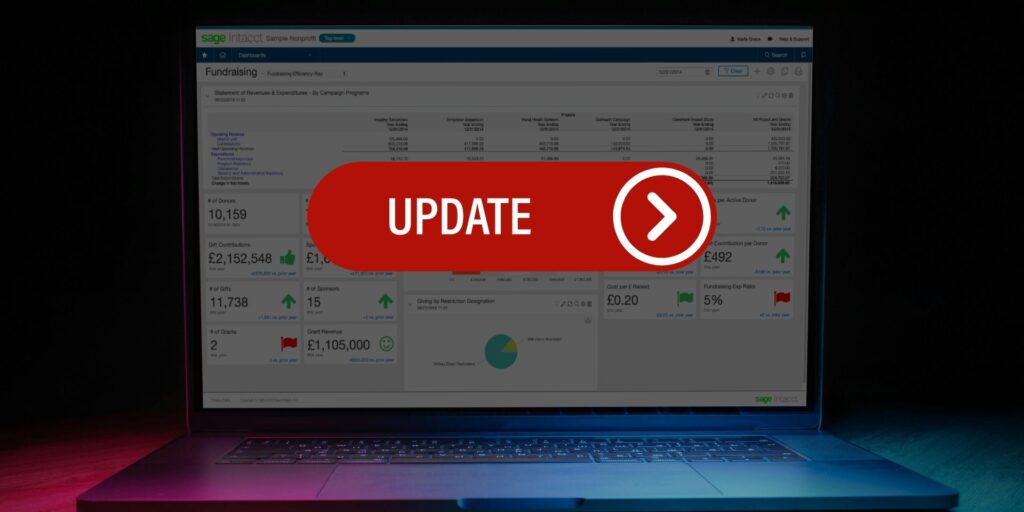
This is where the differences between NetSuite and Sage Intacct become important. The issue wasn’t whether NetSuite could handle their accounting. It was how much work finance had to do to get what they needed from it. Sage Intacct was built around financial management, and its dimensional structure makes it easier for organizations to analyze the same financial information in many ways. Rather than continually expanding the chart of accounts or rebuilding reports, finance can report across locations, departments, programs, entities, and other dimensions while maintaining a much cleaner financial structure.
For a senior living organization, that can have a significant impact. The same underlying financial data can answer very different questions:
- How is one community performing?
- What are labor costs across the organization?
- How does a particular department compare between locations?
- What does the consolidated organization look like?
Since the data is already organized by dimensions like location, department, and entity, the finance team doesn’t have to know every report it will ever need when the system is first configured.
That kind of flexible financial visibility is becoming increasingly important. In Argentum’s research, 85% of executives ranked digital dashboards among their three most common tools for data-informed decision-making, and 78% said the same for one-off reports. Yet only 41% said their organization had implemented a comprehensive, real-time view of financial and operational performance. Clearly, leadership wants to use data to make decisions, but finance needs systems that make it easy to deliver that information in the ways they need it.
Multi-entity accounting, consolidations, allocations, reporting, and dashboards are also areas where the differences become noticeable, particularly when these are activities the accounting team performs every month. This isn’t about checking more boxes on a feature list. It’s about how much effort sits behind those boxes once people start using the system.
What Should You Look For Beyond a Finance Management Software Go-Live?
There is a lesson in seeing multiple senior living finance teams raise similar concerns after making a significant investment in NetSuite. When evaluating finance management software, it’s easy to focus on whether a system can meet a requirement. Can it consolidate entities? Can it handle allocations? Can it produce a particular report? NetSuite could check many of those boxes.
The problem was what happened when the accounting team had to perform those tasks every day and every month. Too many processes still required extra steps, additional applications, spreadsheets, or manual effort. In fact, spreadsheets remain the dominant tool for FP&A professionals, with 96% of survey respondents using them for planning, and 93% using them for reporting purposes on a daily or weekly basis. The goal of new finance management software should be to reduce that reliance, not add another system alongside it.
Being able to meet a requirement isn’t the same as making it easy for finance to get the job done. That’s why there is another question organizations should be asking: How much work will it take our finance team to do these things every month?
Six months after go-live, the requirements checklist matters far less than the results. How long does it take to close the books? How quickly can finance answer management questions? How many spreadsheets still need to be maintained? How many systems do employees have to move between to get their jobs done?
For the organizations we’ve spoken with, those were the questions that ultimately caused them to reconsider NetSuite. They weren’t looking for a different finance management software simply because it had more features. They were looking for a system that could make the day-to-day work of senior living finance easier. That’s what led them to take a closer look at Sage Intacct.
If this sounds familiar, let’s talk. We’ve had these conversations with several senior living organizations, and we’d be happy to have one with you.